How this page works
Each card below is a real theory, insight or tactic that surfaced from a Sad Vinted Faces community member, a lawyer, a PR, a journalist or a Vinted seller. Click the up-arrow to say it rings true for you, and click "Comments" to add your own detail. One vote per person per idea. Comments are moderated.
If you've got a fresh angle nobody's raised yet, scroll to the bottom and email it in.
The counterfeit review process Vinted should actually be running
A concrete process proposal from a community member who has been repeatedly and wrongly accused of selling counterfeit items. The point is not that counterfeit checks shouldn't happen — of course they should. The point is that the account restriction should not fire until a human has looked at the item, the seller has been asked for their side, and one of three outcomes has been reached.
The proposed flow, step by step:
- Item is flagged by the automated system (or a buyer report). The listing is hidden from sale immediately. The account is not restricted.
- A named human agent opens a dialogue with the seller. The seller is told which listing has been flagged and why, and is invited to submit proof of authenticity (receipt, screenshots of the original purchase, authentication certificates, provenance).
- The agent reviews the evidence in real time. One of three outcomes:
- Found to be counterfeit. Account restriction on an escalating scale: 1st offence 24 hours, 2nd offence 72 hours, 3rd offence one week, further offences permanent ban. Repeat counterfeiters get the sanction they deserve.
- Found to be inconclusive. Item is routed through Vinted's own Verification service. Seller must consent; if they decline, the listing is removed. No account restriction. This is the mechanism that lets Vinted resolve grey-area calls without penalising honest sellers.
- Found to be genuine. Listing goes back up. No further action. No mark on the account.
What this fixes. The current pattern documented across the campaign is that a single automated counterfeit flag on a genuine item results in an immediate, often permanent, ban of a Pro seller with hundreds or thousands of five-star reviews. The seller has no route to submit evidence before the sanction lands. Multiple sellers have shown that when they DO manage to get a human review after the fact, the ban is reversed — proof that the initial ban was wrong in the first place. Moving the human step BEFORE the sanction, not after, is the whole point.
What this proposal fixes for Vinted, if they'll listen. Repeat counterfeiters still get progressively harsher sanctions ending in a permanent ban. Grey-area cases get resolved through the Verification service Vinted already runs. Genuine sellers keep their income. The customer-service load on Vinted drops sharply because the appeals-that-reverse-the-ban traffic disappears — the human review has already happened.
Legal anchor. This is very close to what Article 22C UK GDPR (inserted by the Data (Use and Access) Act 2025) already requires as a safeguard around solely automated decisions: information to the data subject, the right to make representations, meaningful human intervention, and the right to contest the decision. Vinted needs to do this anyway. Doing it in the order this community member proposes — before the sanction, not after — is the compliant version.
Source: John Stewart, community member and repeatedly-mis-accused Vinted seller, via email, August 2026. Sad Vinted Faces has the correspondence on file.
Returned parcels vanish in transit, and Vinted keeps the money on a clock the seller cannot beat
A pattern flagged by a community member this week. The seller ships an item to a buyer, the buyer opens a return, the buyer sends the parcel back, and the return never arrives at the parcel shop it was supposed to be delivered to. The seller has no way to collect a parcel that isn't there. Vinted then closes the case with the same rule it applies to any uncollected return: the collection window has lapsed, the funds go to the buyer, the seller loses both the item and the money.
The mechanism is the point. Vinted is enforcing a time-based forfeiture clock on the seller in a scenario where the transit failure is on Vinted's own logistics chain (Vinted Go or the carrier the platform has directed the buyer to use), and where the parcel demonstrably never reached the pickup point. The seller cannot beat a clock that started running on a delivery that didn't happen.
Legal framing worth putting to a consumer lawyer:
- The Payment Services Regulations 2017 do not permit an intermediary to retain a customer's funds without a documented and lawful reason. "The pickup clock ran out" is not a lawful reason when the goods never arrived at the pickup point.
- Section 49 of the Consumer Rights Act 2015 requires reasonable care and skill in the supply of a service. Setting up a return through Vinted's chosen carrier and then holding the seller liable for the carrier's failure to deliver falls short of that standard.
- On the buyer side, this outcome unjustly enriches the buyer at the seller's cost — they got the item, then got a refund, and the seller got neither.
- The word the community member used was "theft". Legally the closer test is conversion (English tort law) plus potential engagement of the Fraud Act 2006 Section 4 (fraud by abuse of position) where the platform sits in a fiduciary-like position over funds it is holding for the seller.
Every seller who has experienced this should log the tracking data (Vinted's own return-label carrier reference), the date the return was raised, the last carrier scan, and the date Vinted closed the case in the buyer's favour. That evidence turns the pattern from anecdote into something a lawyer can act on, and it slots straight into the Article 15 Subject Access Request the campaign already recommends.
Source: A community member via email, August 2026. Sad Vinted Faces has the message on file.
Vinted appears to run its own Pro seller account, "Rescued Value", reselling items from lost Vinted Go parcels — and it's exempt from its own rules
Reported to Sad Vinted Faces by a French professional Vinted seller, writing on behalf of a group of French Pro sellers who have been quietly investigating a Vinted-linked Pro account known as Rescued Value. Contributor identity withheld at their request. What the group has documented is significant.
The account. Around 109,000 to 110,000 listings, with new items added continuously. Registered in both Lithuania and France under the name "Vinted Go", which is Vinted's own delivery and locker network. The account email address itself carries the -vgo@vinted.com suffix, tying it directly to Vinted Go. The account is not visible to UK users, which is why it has flown under the UK radar until now.
Where the stock comes from. French sellers investigating the account believe the items are lost or unclaimed Vinted Go parcels, then resold by Vinted itself. If accurate, Vinted is selling goods it never bought from the original owner — the same original owner who paid for postage and never received their parcel.
UPDATE: publicly confirmed. A July 2026 article in the Dutch trade publication Ecommerce News confirms this. It reports that Rescued Value has given a "second life" to more than 100,000 undeliverable Vinted Go parcels. The piece is framed positively as a sustainability-and-recycling story; it does not address the seller-side questions of consent, the 14-day right of withdrawal, or the disparity in how Vinted's own account is moderated versus everyone else's. But the origin of the stock — lost, undeliverable and unclaimed Vinted Go parcels — is now on the record from Vinted's own PR. Source article: ecommercenews.nl (in Dutch).
The disparity, with screenshots. The account has been auto-banned by Vinted's own moderation system on multiple occasions, and each time it has been restored within minutes. Two screenshots taken by the reporting seller show it clearly:
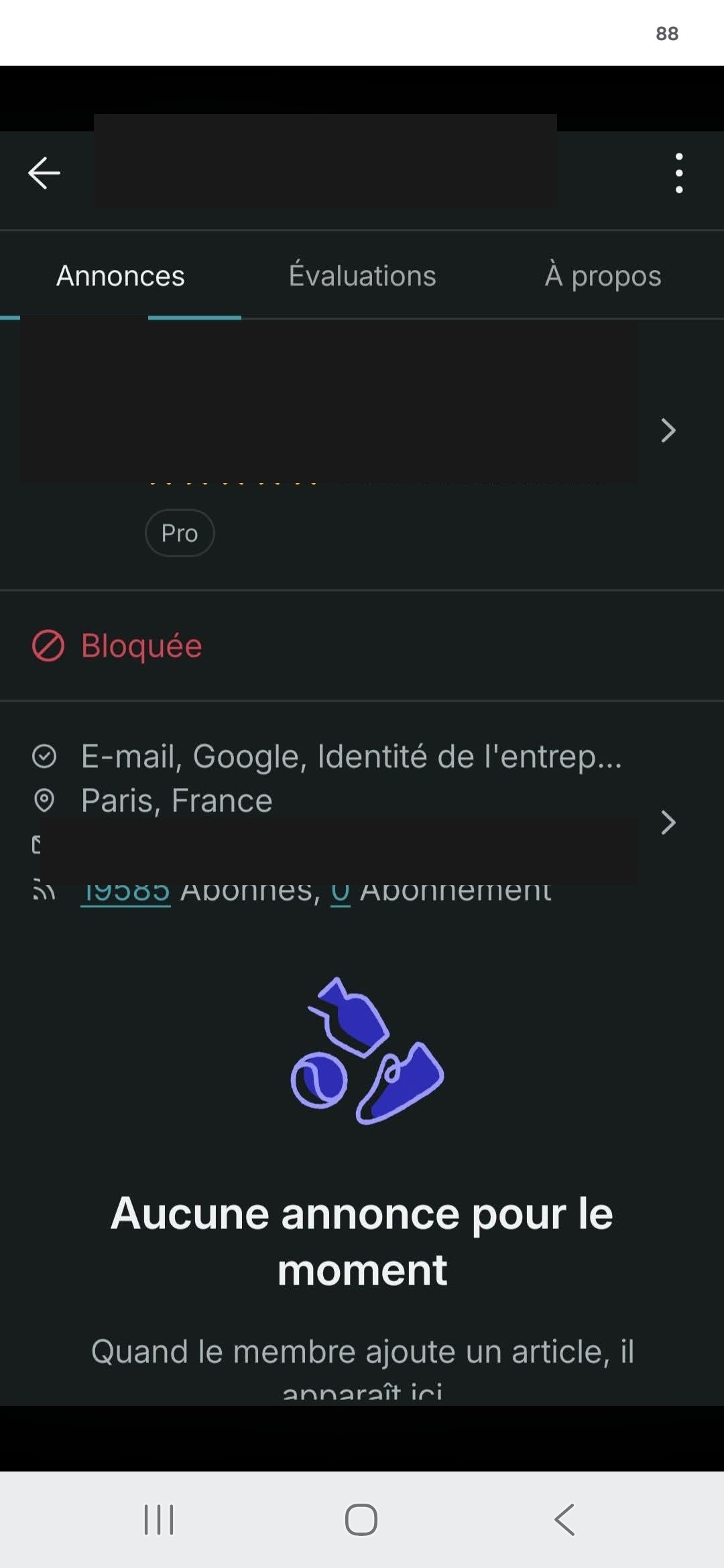
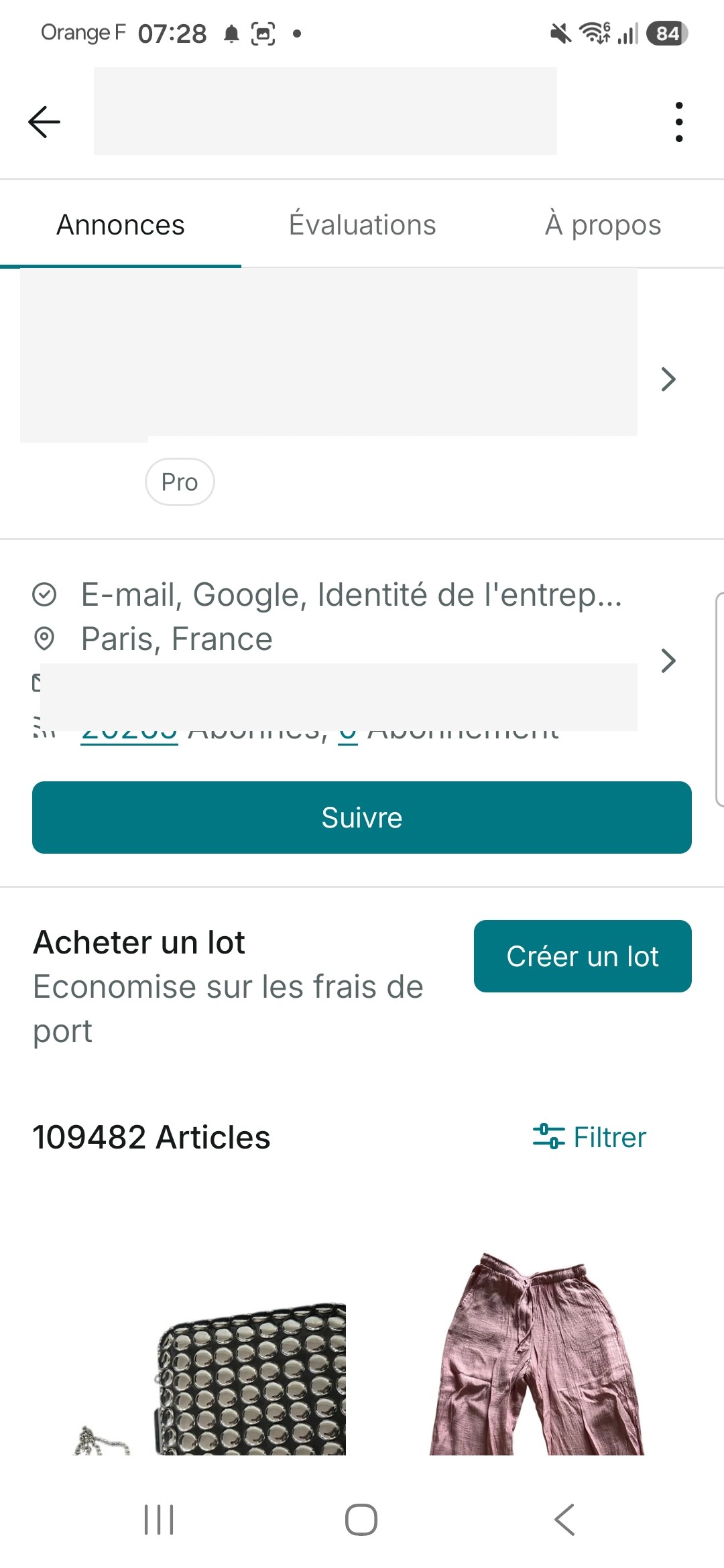
Ordinary Pro sellers subject to the same automated moderation are left restricted for days, weeks, or permanently. That gap is the story: it demonstrates that (a) Vinted's automated ban system does fire on genuine commercial activity, but (b) some accounts have a fast, human, restoration path that other sellers can't access. Every rebuttal Vinted has offered to date on the "why can't I speak to a human" question is contradicted by this single fact.
French consumer-law angle. Under French consumer law (Code de la consommation, transposing EU Directive 2011/83), a professional seller must give consumers a 14-day right of withdrawal. Vinted enforces this on every French Pro seller (payouts are held for 14 days precisely to allow the withdrawal window). Reports from French Pro sellers who have tried to return items purchased from this account say their returns were refused with a templated apology. If accurate, Vinted's own Pro account is breaching the exact rule Vinted forces every other Pro seller to comply with.
Ethical angle. Reselling parcels that customers paid for postage on but never received is, at minimum, an argument the platform needs to answer publicly. Not a question of "did Vinted acquire this lawfully" but "should Vinted be the entity that captures the residual value when its own delivery network fails".
UK relevance. Vinted Go is currently a European product not yet fully rolled out in the UK, so a directly equivalent UK version of this account may not exist yet. But the pattern documented here — Vinted's own account subject to its own moderation, then instantly restored while other sellers cannot get a human review — is a UK-relevant proof point about how the automated moderation actually operates and who gets access to override it. Any CMA, ICO or CEDR review of the Pro seller ban pattern should ask Vinted directly: how many restored accounts belong to Vinted itself, in what median time, and by which named human reviewer.
Sources: a French professional Vinted seller (identity withheld at request) via email, on behalf of a group of French Pro sellers, with documentary screenshots of the account being blocked and restored (reproduced above with account identifiers redacted). Ecommerce News (Netherlands), July 2026, confirming Rescued Value has resold over 100,000 undeliverable Vinted Go parcels. Sad Vinted Faces has all correspondence and unredacted screenshots on file.
The Pro-seller purge only makes sense as a pre-IPO valuation play
A sharp reader question worth taking seriously. Vinted has been widely reported as preparing for a European IPO. Public-market valuation multiples for pure C2C peer-to-peer marketplaces (network-effects businesses like Etsy or Poshmark) are structurally higher than for marketplaces that intermediate professional sellers, which trade closer to a retail multiple. A marketplace visibly dominated by Pro sellers also attracts materially more regulatory obligation: the retained EU Platform to Business Regulation 2019/1150 (statement-of-reasons, 30-day notice, mediation), the EU Digital Services Act (Vinted is already a designated Very Large Online Platform), DAC7 tax reporting to HMRC, VAT and product-liability rules that apply to traders but not to individuals. The commercial logic of suppressing the visible Pro-seller layer ahead of a listing is real.
On the campaign evidence, that logic maps cleanly onto what respondents actually experience. Pro accounts are marketed as the compliant path for regular selling, then banned for "commercial selling" — the exact activity the account exists to permit. Standard consumer accounts are pushed into "you must go Pro" flows, then, once on Pro, purged. Wallet balances are retained, absorbing part of the revenue the platform would otherwise recognise from the Pro seller. Every one of those steps is what a marketplace does when it wants to shrink the visible Pro-seller share of its GMV without publicly acknowledging a strategy shift.
This is put on record as a theory worth testing, not as an assertion of proven motive. Alternative explanations exist (cost-cutting on human review, an over-aggressive fraud model, coordinated peer-report abuse Vinted hasn't filtered for) and any one of them would also produce the observed pattern. But if the IPO-motive theory is correct, it materially changes the analysis. It becomes a specific form of abuse-of-dominance under Chapter II of the Competition Act 1998 — dominance being used to distort competition between two classes of sellers on the same platform — and, separately, a potential misrepresentation to prospective investors and their underwriters, which is a securities-law issue. It is a question the CMA, financial regulators, and any journalist covering the IPO are well placed to put directly to Vinted.
Source: Sad Vinted Faces community member via email, August 2026. Consistent with the CMA's own July 2026 finding that Vinted holds 50–60% of the UK C2C apparel market (eBay / Depop merger inquiry).
Three claims Vinted keeps repeating with zero evidence, and one big data hole no one is asking about
Every time Vinted responds to a story, the same three lines come back, and nobody in press or in regulation is following up to test them:
1. “Buyers can contact us if there's an issue.” Yes they can. Nobody is checking whether Vinted then does anything. The lady in the BBC feature only got her refund because the BBC asked on her behalf. Millions of other buyers use the same route and are ignored. If the “buyers can contact us” line is going to keep being accepted in coverage, someone needs to publish the resolution rate.
2. “The vast majority of our users are happy.” On what data? What sample, over what period, measured how? How many people work in Vinted customer service? How many cases and complaints are opened per day? How many are closed unresolved, or auto-closed on a timer with no human ever having replied? Every one of those is a specific number Vinted could give and hasn't.
3. You can't download your own sales, refund or purchase data. On any comparable platform this is a CSV export button. On Vinted it isn't there. To chase a case you have to scroll through months of in-app messages by hand because there's no filter, no search, and no transaction reference. When you ask for the data formally, the case sits open for weeks and then closes on Vinted's clock without a reply. Catherine asked for hers weeks ago and heard nothing back, exactly like the survey respondents who describe the same experience.
After all the campaign effort, all the coverage across The Times, The i Paper, BBC News, ITV and BBC Radio 4, and all the direct approaches to Adam Jay and to investors, if Vinted still hasn't engaged, that is the answer. Voluntary reform isn't coming. The precedent is Etsy: sellers campaigning for years over withheld funds only saw the platform change course when the regulator stepped in. Legislation, or at minimum a live investigation by the CMA and the ICO, is what will actually move the needle here.
Source: Catherine Warrilow, drawn from 5,000+ Sad Vinted Faces respondents and every published Vinted response to date.
Vinted lets sellers accrue a balance, then bans and keeps it. That is potentially the fraud, not the seller's
A recurring pattern in the survey and in DMs: a seller lists, sells and dispatches perfectly ordinary items, gets to a pending balance of a hundred pounds or more, and only then is permanently banned for "fraudulent activity" or "counterfeit". No buyer complaint on record. No returned item. No evidence produced. And Vinted retains the balance.
Set out plainly, the sequence is this. Vinted takes the fee on every sale as it happens. Vinted holds the seller's share in a pending balance. Once the balance builds up, the account is closed with no proof of any breach, and the money never reaches the seller. If Vinted cannot show that specific transactions were fraudulent, on what legal basis does the platform then keep the money for those transactions? The Payment Services Regulations 2017 do not permit an intermediary to retain a customer's funds without a documented dispute reason. The Consumer Rights Act 2015 does not permit unfair contract terms to override that. And, taken together, the Fraud Act 2006 offence of fraud by false representation is defined precisely as making an untrue statement (here: "you are a fraudulent seller") to make a gain or cause a loss.
The class-action point makes itself. The number of sellers with genuinely accrued Vinted balances that were permanently withheld after an unevidenced counterfeit ban is now in the thousands, and the individual sums range from tens of pounds to five figures. Anyone thinking about a group litigation order should be starting here, not with the ban decisions themselves.
Source: SamNic211 via Instagram DM to the campaign, August 2026. Consistent with dozens of matching survey stories and the ongoing Wright Attire / dpuk77 / tdyke48 patterns.
UK GDPR Article 22 and DSAR failures could carry a class action
A commercial litigation solicitor at a major UK all-services firm reviewed the campaign evidence and said the aggregate pattern likely supports a high-profile class action. His strongest lead: Vinted's automated ban process and the pattern of Subject Access Requests being ignored or answered outside statutory timescales. Article 22 (and the newly inserted Article 22A) prohibits solely automated decisions with legal or significant effect unless meaningful human intervention is offered. The class strengthens with every documented case of a missed 30-day SAR deadline.
Source: Commercial litigation solicitor, direct email to the campaign, August 2026.
Vinted is likely breaching the DMCC Act 2024 professional-diligence duty
A separate consumer lawyer, unprompted, told Catherine his view is that a lot of what Vinted is doing is probably illegal. Specifically, he points to the Digital Markets, Competition and Consumers Act 2024 obligation on traders to act with professional diligence, and the ban on unfair contract terms under the Consumer Rights Act 2015. Undefined terms like "commercial selling" and "large volumes" that are used as the stated basis for account restriction are unlikely to be enforceable in the way Vinted currently applies them.
Source: UK consumer lawyer, direct message to the campaign, August 2026.
Vinted Pro sellers have a right to CEDR mediation. Vinted is ignoring the forms
A Sad Vinted Faces community member, a Vinted Pro seller banned about a month ago, discovered the mediation route in Vinted's own Pro Guide at 2.7 and Pro Terms and Conditions at clause 26. She completed the CEDR mediation form and sent it to Vinted for their section on 1 August. Three weeks in, followed up multiple times, no response. Every reply came from the same automated sender name (see the "Yulia" theory below). If enough Pro sellers submit the same form and record the non-response, that's a documented breach of a clause in Vinted's own Pro contract.
Source: A Vinted Pro seller via Instagram DM, August 2026.
Malicious peer-to-peer reporting is triggering many of the bans
Multiple Pro sellers who downloaded their own Vinted data via a Subject Access Request found that their repeated restrictions correlated directly with coordinated reports from a small handful of competing accounts. Vinted's automated system weights buyer and peer reports heavily with no apparent filter for coordinated abuse. Two or three coordinated reports can flip an account from active to restricted overnight, without any human ever checking whether the reports were genuine. See the campaign's guidance on how to spot and challenge it at /help#q28.
Source: Multiple Pro sellers who downloaded their own Vinted data via a SAR, plus dozens of matching survey stories.
The peer report may be Vinted's fig leaf for "human intervention"
A sharp theory from a community member: Vinted's bans for commercial selling, fake items and photos taken from the web all rely on a user reporting the account first. That user report, whether malicious or genuine, could be exactly how Vinted argues it satisfies the human-intervention requirement under UK GDPR Article 22. The AI then agrees or disagrees with the report and closes the case. It looks automated on the surface, but Vinted's legal position may be: "a human did make an input, it just wasn't one of ours". If that framing holds up, it exposes the whole design flaw. Article 22 requires meaningful human intervention by the controller, not a random third party with a possible grudge. This is a specific line worth putting to Vinted in a Subject Access Request: "Please confirm whether third-party user reports are relied upon as the human element in decisions affecting my account under Article 22."
Source: A community member via email, August 2026.
A well-crafted Letter Before Claim can get you off Vinted's AI review list
A community member got her account fully restored after sending a formal Letter Before Claim to Vinted's legal team, referencing Article 22 GDPR and the pattern of automated decisions. She followed up with a second message confirming that since sending it, "all bot surveillance on my account has completely stopped". Two items reviewed since have been cleared without incident. The letter format is now the LBA template on /take-action, and the correspondence log template is designed to record exactly the kind of evidence Vinted's legal team acted on.
Source: Sellers whose accounts were restored after sending a Letter Before Claim, direct emails to the campaign, August 2026.
Meet "Yulia", the reply-bot Vinted signs its automated responses with
A striking pattern in the community: an unusual number of Vinted responses are signed off "Yulia". Community members comparing notes report Yulia sending the same word-for-word reply to unrelated appeals, at unrealistic response times. The signature is likely a bot with a human name grafted on to make its responses look like human review. If Vinted claims a human has reviewed your appeal, the identical wording across cases (and the seconds-long reply time) is strong Article 22 evidence.
Source: Community members comparing notes via Instagram DM, cross-referenced by multiple survey respondents.
The Vinted chaos is hitting neurodivergent sellers disproportionately hard
A community member suggested opening a "neurodivergent front" on the campaign. Sellers with ADHD and autism describe a specific and disproportionate impact: Vinted was often the accessible, low-friction income stream that worked around their conditions. When the ban lands with no explanation, the executive-function and communication demands of fighting an automated system (drafting appeals, chasing bot replies, rewriting the same thing repeatedly) fall hardest on the people the platform's clarity failures penalise most. The point has been echoed by a national broadcaster researcher who has been reviewing case studies for a daytime TV feature.
Source: A community member proposing the neurodivergent-focused strand, direct email to the campaign, August 2026. Echoed by a national broadcaster researcher.
Go through the producer, not the presenter, and take Martin Lewis with you
A senior PR specialist reviewed the ITV opportunity and gave a clear route: for the ITV This Morning coverage, go through the producer (Clare Miller) rather than pushing at the presenters directly, and pair the story with a Martin Lewis angle so it lands on the money desk as well as the consumer desk. The wider point: the campaign is now big enough that individual outlet chasing is not the highest-leverage move. A named PR contact routing the story from one producer to the next is.
Source: A senior PR consultant, direct email to the campaign, August 2026.
A Vinted Pro account may be reselling lost or unclaimed Vinted Go parcels
A French Vinted user surfaced a Pro account, "Rescued Value", registered in both Lithuania and France under the name Vinted Go — Vinted's own delivery service. Her working theory, based on the pattern of listings, is that the account is selling items that came from lost or unclaimed parcels inside Vinted's own delivery network. If that holds up, Vinted is potentially reselling parcels that went missing from its own infrastructure back to the public. Still an investigation lead, not proven. But worth pursuing.
Source: A French Vinted user, direct email to the campaign, August 2026.
Vinted is prepping for IPO and the AI-first strategy is a pre-listing cost cut
Widely repeated theory across the community: Vinted has grown too fast, replaced most of its human customer-service and moderation with an aggressively-tuned AI stack to compress costs ahead of an IPO, and is now living with the consequences. The renamed "Buyer Protection fee" (relabelled to "Vinted fee" on 19 August 2026 after sustained pressure) fits the same pattern of extracting more per-transaction revenue while under-investing in the human infrastructure that would make the platform trustworthy. If the IPO angle is real, regulatory scrutiny from the CMA and ICO in the run-up to listing becomes a much bigger commercial problem for Vinted.
Source: Recurring theme across community messages and campaign correspondence.
The Pro-account trap: told to go Pro, then banned for commercial selling
One of the most common patterns in the survey. Vinted tells a seller their activity looks commercial and directs them to convert to a Pro account. The seller does everything asked: registers with HMRC, publishes the Additional Policies page, pays the Pro commission. Weeks or months later, the same account is banned for "commercial selling", which is the exact activity a Pro account is designed to permit. Vinted has never publicly reconciled the contradiction. Full breakdown at /help#q23.
Source: 400+ scaled survey respondents.
UK feeds are being flooded with US and Australia listings
An emerging pattern flagged by the community: UK Vinted users are increasingly seeing US and Australia listings dominate their feed, item searches and "recommended for you" panels. The working theory is that Vinted is quietly boosting exposure of listings in its newer US and Australian markets to seed those regions with buyer activity, at the expense of the UK user experience. The knock-on effect for UK sellers is real: their own listings become harder to surface for UK buyers, and buyers get frustrated hitting international shipping costs on items they thought were local. If you're seeing this in your feed, add a comment describing where you are and what proportion of your recommendations are now non-UK.
Source: A community member via Instagram DM, August 2026.
Where sellers are going next: eBay, Wevone, Minted, Bidzzy
Community members are actively hunting for a Vinted replacement. Four names come up most often. eBay is the obvious fallback for volume and buyer protection, though fees are higher. Wevone and Minted are UK-based second-hand marketplaces positioning themselves as the calmer alternative, with clearer rules and slower moderation. Bidzzy is the auction-style option people are trying for higher-value items where you want a bidding war rather than a fixed price. None have Vinted's scale yet, but if this cost sellers even 10% of their user base the arithmetic starts to bite. Add your favourite in the comments and tell everyone what's actually working.
Source: Community speculation, cross-referenced with survey free-text mentions of alternative platforms.
Phishing accounts posing as Vinted are actively targeting banned sellers
A live and worsening scam pattern. Community members have reported Facebook groups with tens of thousands of followers posing as Vinted support: sellers are contacted by someone claiming they will escalate a complaint and offer compensation, on the condition they hand over more details. Sad Vinted Faces itself is being targeted by the same playbook: a TikTok account called "Vinted" has been DM-ing the campaign with links to tap, and callers pretending to be from Vinted have repeatedly tried to call. The pattern is the same: banned sellers are vulnerable, desperate for a way in, and easy to convert. Never engage. Report the account and, if money is involved, report to Action Fraud on 0300 123 2040. Named impersonator accounts are listed on /take-action.
Source: Multiple community reports via email and TikTok DM, August 2026.
Vinted's SAR data pack still doesn't prove human review happened
An insight from a community member via TikTok DM: the pack Vinted sends in response to a Subject Access Request typically shows what data they hold, but doesn't include the meaningful human-review record for the decision that affected your account. That's the exact information Article 22 UK GDPR entitles you to and the specific gap the campaign is asking the ICO to investigate. If your SAR reply arrives and doesn't show a documented human review of the decision to restrict or ban you, that omission is itself a reportable breach.
Source: A community member via TikTok DM, August 2026.
Persistent challenges are producing permanent-ban reversals with a written apology
A community member via TikTok DM reports that a growing number of people with permanent bans are getting their accounts back plus a written apology from Vinted admitting the ban was a mistake. That written admission matters: it becomes evidence that the automated system got the decision wrong. Each admission of error strengthens the wider case that Vinted is running Article 22-breaching automated decisions at scale. If you have received one of these apologies, please forward it to the campaign so it can be added anonymously to the ICO submission.
Source: A community member via TikTok DM, August 2026.
Buyer Protection was a fee, not protection. Vinted just renamed it
The Buyer Protection fee was long argued to be misleading: buyers reported paying it and then being ignored, refunded but with the item retained by the seller, or given no protection at all when the transaction went wrong. On 19 August 2026 Vinted quietly renamed it to a plain "Vinted fee" in buyer-facing copy. The fee itself remains. The rename is a de facto admission that the original framing potentially engaged CPUTRs 2008 (misleading actions on fee framing) and is the specific evidence the CMA complaint now cites.
Source: Multiple survey stories, UK consumer lawyer view, and the Vinted product change of 19 August 2026.
Got a fresh theory or insight?
If you've spotted a pattern, found a legal angle, or discovered a workaround that nobody's raised yet, email Catherine at camwarrilow@gmail.com with "Community idea" in the subject line. New ideas that hold up get added to this page.
Send your idea →